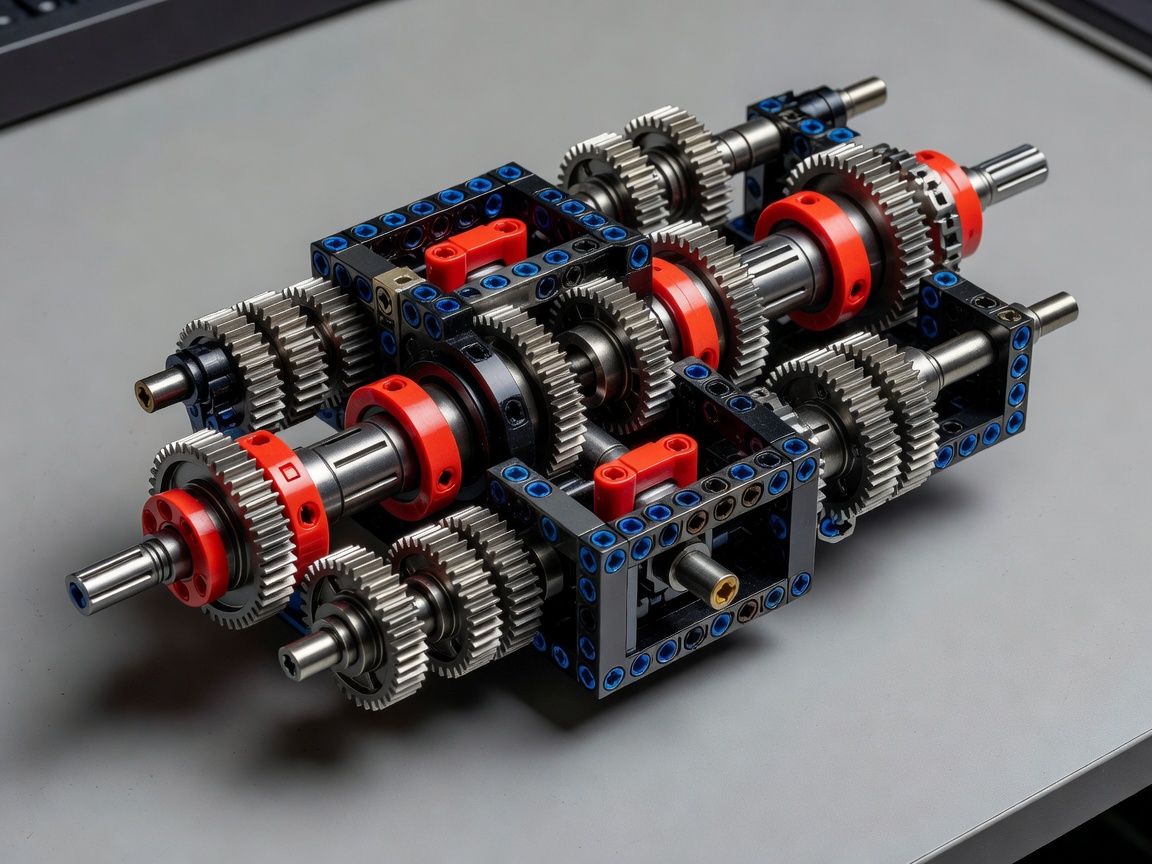
LEGO Technic is not merely a model building medium; it is a true discrete prototyping mechanical engineering system. Through specialized axles, bevel gears, linear actuators, and structural liftarms, builders can construct high-reduction transmission units and complex multi-link suspensions.
1. Studded Versus Studless Architecture
The evolution of Technic divides into two distinct mechanical epochs: traditional studded beams (dominant from 1977 to approximately 2000) and modern studless liftarms.
Traditional studded Technic utilized standard bricks featuring cross-axle holes along their vertical web. While simple to integrate with standard System bricks, studded structures suffered from catastrophic shear weakness along horizontal tensile axes. When subjected to significant motor torque, stacked bricks tend to separate along their horizontal clutch seams.
Modern studless construction relies on injection-molded Polycarbonate and ABS beams (liftarms) joined with friction and non-friction pins. By utilizing triangular bracing and cross-pinning, studless chassis achieve isotropic rigidity, sustaining substantial torsional loads without risk of seam separation.
Structural System Trade-Offs
| Mechanical Metric | Studded Beams (Classic) | Studless Liftarms (Modern) |
|---|---|---|
| Torsional Stiffness | Low; separates along clutch seams | High; locked across triangulation pins |
| Spatial Volume | Larger envelope; bulky vertical bricks | Compact; 1-module beam thickness |
| System Integration | Direct vertical stacking with System bricks | Requires pin-to-stud adapter plates |
| Diagonal Geometry | Restricted to Pythagorean right triangles | Flexible via multi-angle bent liftarms |
2. Fundamental Gear Kinematics & Pitch Circles
Technic gearing operates on an 8-tooth modulus standard. To achieve perfect tooth meshing without binding or slippage, the sum of the tooth counts of two parallel gears divided by 16 must equal the stud spacing between their axle centers:
Axle Pitch (studs) = (Teeth Gear A + Teeth Gear B) ÷ 16
For example:
- 8T Gear + 24T Gear: (8 + 24) ÷ 16 = 2 studs center-to-center distance (3:1 ratio).
- 12T Bevel + 20T Bevel: (12 + 20) ÷ 16 = 2 studs center-to-center distance (5:3 ratio).
- 16T Gear + 16T Gear: (16 + 16) ÷ 16 = 2 studs center-to-center distance (1:1 direct ratio).
- 8T Gear + 40T Gear: (8 + 40) ÷ 16 = 3 studs center-to-center distance (5:1 high reduction).
3. Torque Management, Clutching & Axle Twisting
When utilizing high-RPM electric motors, gearing down increases torque proportionally while reducing rotational speed. However, excess torque introduces physical failure modes:
- Axle Torsion: Technic cross-axles are manufactured from Polyoxymethylene (POM / Acetal) or ABS. Under heavy loads exceeding 15–20 N·cm, long axles (6M or longer) exhibit noticeable rotational twist, introducing phase delay and backlash into steering linkages and crane boom lifters.
- Tooth Stripping: Standard 8-tooth spur gears possess narrow tooth profiles capable of skipping under abrupt stall torque. Heavy duty assemblies replace them with double-bevel gears or worm gear drives.
- 24T White Clutch Gears: Engineered with internal spring-loaded slip ratchets that slip automatically at approximately 2.5 to 5 N·cm of resistance, protecting expensive motors and gearboxes from permanent plastic deformation during end-stop collisions.
4. Differentials and Drive Linkages
In multi-axle vehicle design, a differential gear cage splits input power between two output half-shafts while allowing them to rotate at varying angular velocities during cornering. Technic differentials utilize miniature internal 12T bevel or 14T bevel gears. In high-power motorized crawlers, open differentials can cause total loss of traction if a single wheel loses grip; builders therefore employ mechanical differential locks operated by pneumatic cylinders or mini linear actuators.